

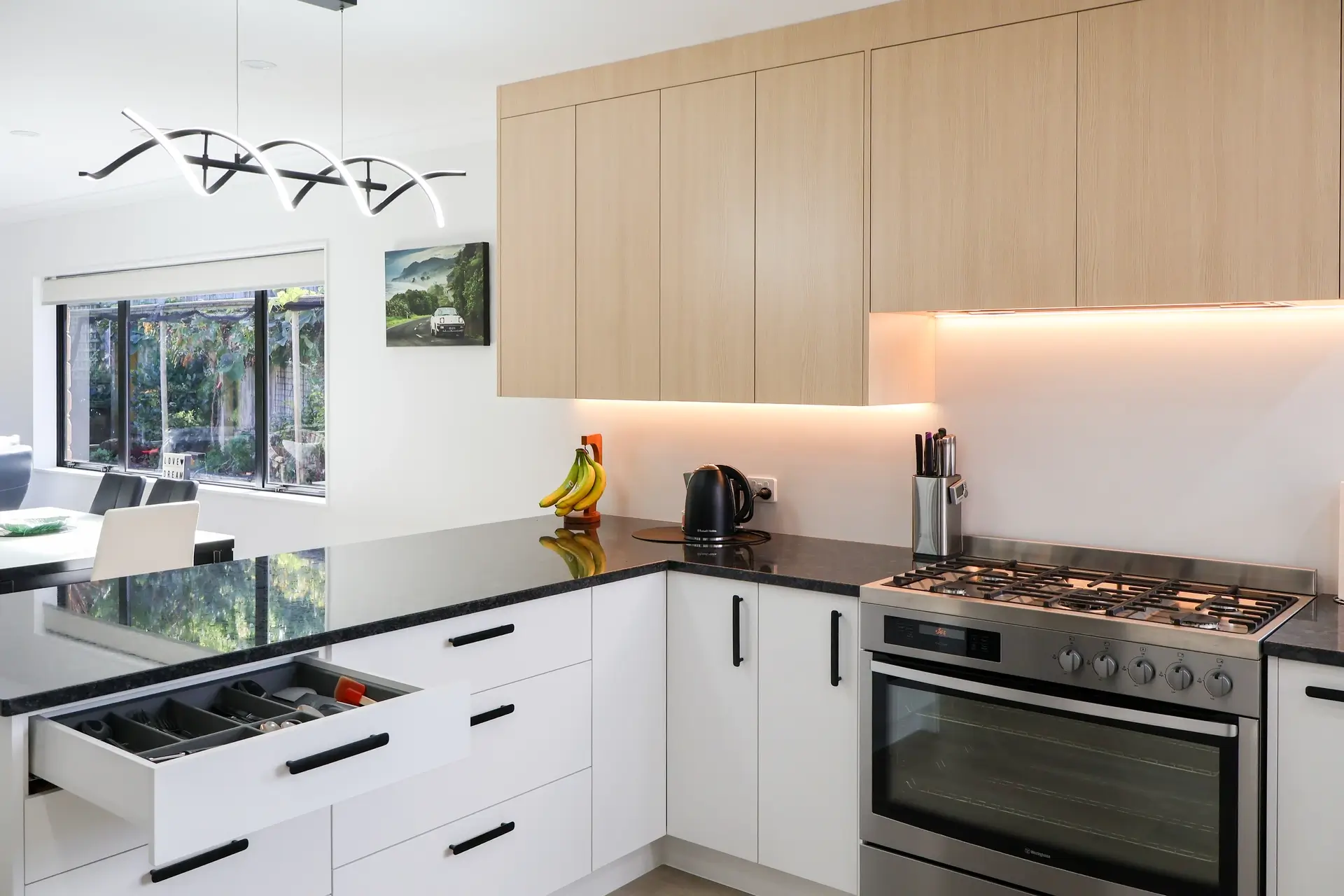
Many Kapiti Coast homes feature charming character villas, cosy beach cottages, and compact townhouses—properties full of personality but often working with modest kitchen footprints. Whether you’re in a 1950s Paraparaumu villa, a Waikanae Beach holiday cottage, or a Raumati character home, small kitchens present unique challenges alongside genuine opportunities for clever design.
The good news? Size doesn’t determine impact. With strategic planning, smart storage solutions, and thoughtful material choices, compact kitchens can feel spacious, function beautifully, and look genuinely stunning. At Chatswood Kitchens, we’ve transformed hundreds of small Kapiti Coast kitchens over four decades, proving that limited square metres never limit quality or style.
This guide explores proven strategies for maximising small kitchen spaces, drawing on real local examples from character homes across the Kapiti Coast. Whether you’re planning a complete renovation or targeted updates, these techniques help you create a kitchen that feels considerably larger than its actual dimensions whilst remaining fully functional for daily family life.
Key Takeaways
- Vertical storage transforms small kitchens by utilising space to ceiling height, effectively doubling storage capacity without expanding floor area
- Light colours and reflective surfaces create perceived spaciousness, with pale cabinetry and glossy finishes bouncing light throughout compact spaces
- Corner solutions eliminate wasted space through carousel units, pull-out systems, and diagonal cabinetry that access previously unusable areas
- Multi-functional islands work harder by combining preparation space, storage, seating, and sometimes dining into a single compact footprint
- Integrated appliances save visual and physical space by eliminating bulky freestanding units that consume valuable floor area
- Strategic lighting layers including under-cabinet, toe-kick, and pendant lighting make small kitchens feel brighter and more open
- Glass and mirrored elements create depth illusions through splashbacks and cabinet fronts that visually expand compact spaces
- Character home constraints require creative solutions rather than compromise, with heritage features often becoming design assets when approached thoughtfully
Understanding Kapiti Coast’s Unique Kitchen Challenges
Kapiti Coast properties present distinctive characteristics affecting kitchen design. Understanding these local factors helps homeowners approach small kitchen renovations strategically rather than fighting against inherent property features.
Character Villa Constraints
Many Paraparaumu and Waikanae villas date from the 1900s-1950s, featuring original kitchen footprints designed for different lifestyles. These spaces typically measure 8-12 square metres, reflecting an era when kitchens served purely functional purposes rather than today’s expectation of social, multi-use spaces.
Original villa kitchens often feature awkward layouts with doors positioned inconveniently, windows in fixed locations, and structural walls limiting reconfiguration options. Ceiling heights sometimes exceed modern standards (beneficial for vertical storage), whilst floor areas remain genuinely compact.
Beach Cottage Realities
Waikanae Beach, Raumati, and Peka Peka cottages frequently feature holiday-home heritage, with kitchens originally designed for occasional weekend use rather than daily family living. As these properties transition to permanent residences or substantial holiday homes, kitchens require functional upgrades within existing compact footprints.
These cottages often feature charming character—exposed beams, original windows, coastal positioning—that renovtruction should enhance rather than eliminate. Balancing heritage charm with modern functionality requires particular sensitivity in small cottage kitchens.
Modern Townhouse Efficiency
Newer Kapiti Coast townhouses and units, whilst contemporary, often feature deliberately compact kitchens maximising other living areas. These spaces typically range 6-10 square metres, designed for efficiency rather than expansive cooking and entertaining.
Unlike character homes, townhouses usually feature straightforward rectangular or galley layouts without heritage constraints. This simplicity actually simplifies renovation planning, though space limitations remain equally challenging.
Coastal Environment Considerations
Regardless of property type, Kapiti Coast’s coastal position introduces specific material and design considerations. Salt air exposure, humidity variations, and UV intensity affect material longevity and performance. Small kitchens particularly benefit from materials specifically suited to coastal conditions, as limited ventilation in compact spaces can exacerbate moisture-related issues.
Vertical Storage: Your Greatest Space-Saving Asset
Small kitchens typically waste enormous potential storage by ignoring vertical space above standard cabinet height. Maximising ceiling-height storage represents the single most impactful strategy for compact kitchen transformation.
Extending Cabinets to Ceiling Height
Standard upper cabinets typically stop 300-400mm below ceiling height, creating awkward gaps collecting dust whilst wasting valuable storage potential. Extending cabinetry fully to ceiling height (or installing bulkhead cabinets above standard uppers) can increase storage capacity by 30-40% without consuming additional floor space.
For villa kitchens with generous ceiling heights (often 2.7-3.0 metres), this strategy proves particularly valuable. The additional height accommodates rarely-used items—special occasion serveware, bulk storage, or seasonal equipment—in upper zones whilst keeping frequently-used items accessible in lower, more convenient positions.
Installation typically costs $1,500-$3,000 for full-height cabinet extension across average kitchen runs, representing excellent value for substantially increased storage capacity.
Strategic Shelving Above Standard Storage
Where full cabinet extension proves impractical or too costly, open shelving above existing cabinets offers a budget-friendly alternative. Floating shelves ($150-$400 for materials) create additional storage whilst adding visual interest and perceived openness compared to solid cabinet doors.
This approach works particularly well in character homes, where open shelving can complement heritage features whilst providing practical storage for cookbooks, decorative items, or frequently-used crockery.
Tall Pantry Solutions
Freestanding or built-in tall pantry units (2,000-2,400mm height) maximise vertical storage in a narrow footprint, ideal for small kitchens lacking space for expansive cabinet runs. Pull-out pantry systems within these tall units provide excellent organisation, allowing full visibility and access to contents without deep, hard-to-reach shelving.
Quality pull-out pantry systems cost $800-$1,500 installed, delivering storage capacity equivalent to much larger traditional cabinet arrangements whilst consuming minimal floor space—often just 300-400mm width.
Ceiling-Mounted Storage Solutions
For exceptionally compact kitchens, consider ceiling-mounted pot racks or hanging storage systems. These solutions work particularly well in cottage kitchens with exposed beam features, turning structural elements into functional storage whilst maintaining character charm.
Smart Corner Solutions: Eliminating Wasted Space
Corner areas represent some of the most poorly utilised space in small kitchens. Traditional corner cabinets often waste 30-50% of available space due to access difficulties. Modern corner solutions transform these problem areas into highly functional storage zones.
Carousel and Lazy Susan Systems
Rotating carousel systems ($400-$800 installed) transform awkward corner cabinets into fully accessible storage. These systems allow items stored at the back of deep corner spaces to rotate forward, eliminating the frustrating reach-and-search process traditional corner cabinets require.
For character villa kitchens with original corner configurations, retrofitting carousel systems into existing cabinet frames often proves more cost-effective than complete cabinet replacement whilst dramatically improving functionality.
Diagonal Corner Cabinet Design
Rather than standard L-shaped corner cabinets, diagonal corner designs create more usable interior space whilst presenting a more open, less bulky appearance from outside. This approach particularly suits smaller kitchens where visual bulk matters as much as storage capacity.
Diagonal corner units cost $600-$1,200 more than standard corner cabinets but deliver significantly improved usability and a more streamlined aesthetic—valuable in compact spaces where every visual element affects perceived spaciousness.
Corner Drawer Systems
Innovative corner drawer systems ($700-$1,400 installed) provide full-extension access to corner storage, eliminating the reaching and crouching traditional corner cabinets require. These systems particularly suit lower cabinet corners, providing excellent organisation for pots, pans, and bulky cookware.
Open Corner Shelving
For upper cabinet corners, consider open shelving rather than traditional cabinet doors. This approach eliminates the functional challenges of corner cabinet doors (which often can’t open fully due to adjacent cabinetry) whilst creating a lighter, more open feel—particularly valuable in small kitchens where visual openness matters significantly.
Multi-Functional Islands: Doing More With Less
Kitchen islands might seem impractical for small spaces, but appropriately-sized, multi-functional islands can actually improve functionality whilst adding valuable storage and workspace.
Compact Island Sizing
Rather than dismissing islands entirely, consider compact versions (900-1,200mm length) that provide genuine functionality without overwhelming small kitchens. These appropriately-scaled islands offer additional preparation space, storage, and sometimes seating without consuming excessive floor area.
Minimum clearance requirements (900mm on all sides for comfortable movement) determine whether your specific kitchen accommodates an island. Careful measurement and planning ensures islands enhance rather than hinder functionality.
Mobile and Flexible Island Solutions
For genuinely tight spaces, consider mobile islands on locking castors. These provide island functionality when needed whilst allowing relocation for additional floor space during entertaining or when extra clearance proves necessary. Quality mobile islands cost $800-$2,000 depending on materials and features.
Islands with Integrated Storage
Maximise island functionality through integrated storage solutions: pull-out bins, appliance garages, or open shelving on the non-working side facing living areas. This approach ensures your island contributes storage capacity rather than simply consuming floor space for minimal benefit.
Seating Integration
Where space allows, incorporating seating (even just 2-3 stools) transforms islands into multi-functional zones serving food preparation, casual dining, and social interaction simultaneously. This proves particularly valuable in small kitchens where separate dining areas might not exist.
Strategic Colour and Material Choices
Colour and material selection significantly impacts perceived spaciousness in small kitchens. Strategic choices create genuine visual expansion without any structural changes.
Light, Reflective Cabinet Colours
Pale colours—soft whites, light greys, gentle creams—reflect available light throughout compact spaces, creating airier, more expansive feelings compared to darker tones. Whilst dramatic navy or black cabinets look stunning in larger kitchens, small spaces generally benefit from lighter palettes maximising light reflection.
This doesn’t mean small kitchens must feel clinical or boring. Soft sage greens, warm creams, or gentle blues provide personality whilst maintaining light-reflecting benefits. Reserve darker, dramatic colours for small accent areas (perhaps a feature wall or island) rather than dominant cabinet colours.
Glossy and Reflective Surfaces
Glossy cabinet finishes reflect more light than matte alternatives, contributing to perceived spaciousness. Whilst matte finishes offer contemporary appeal and reduced fingerprint visibility, small kitchens particularly benefit from at least some glossy elements—perhaps glossy upper cabinets paired with matte lower cabinets for practical fingerprint resistance where hands frequently contact surfaces.
Consistent Colour Schemes
Small kitchens benefit from cohesive, limited colour palettes rather than busy, multi-coloured schemes. Consistent colouring throughout cabinets, walls, and major elements creates visual continuity, preventing the eye from being interrupted by competing colours that can make spaces feel busier and smaller.
Light-Coloured Benchtops
Pale benchtops—whites, light greys, or subtle stone-look patterns—complement light cabinetry whilst reflecting light effectively. Dark benchtops, whilst striking, absorb light and can make compact spaces feel heavier and smaller.
Strategic Use of Glass and Mirrors
Glass splashbacks reflect light more effectively than tiled alternatives, contributing to spaciousness. Consider mirrored or highly reflective splashback materials in particularly compact kitchens, as these create genuine depth illusions, making spaces appear larger than actual dimensions.
Lighting Strategies for Small Kitchens
Proper lighting dramatically affects how spacious small kitchens feel. Strategic, layered lighting eliminates shadows and dark corners that make compact spaces feel smaller and less inviting.
Under-Cabinet Lighting
LED strip lighting installed beneath upper cabinets ($200-$500 for average kitchens) illuminates benchtop work areas whilst eliminating shadows cast by upper cabinetry. This lighting layer proves particularly valuable in small kitchens where natural light might be limited by nearby buildings or landscaping.
Toe-Kick Lighting
Installing subtle LED lighting in toe-kick spaces beneath lower cabinets ($150-$350) creates a floating, lighter appearance for cabinetry whilst adding practical illumination for floor-level tasks. This technique particularly benefits small kitchens by visually “lifting” cabinets away from the floor, creating perceived additional space.
Strategic Pendant Placement
Where island or peninsula space allows, well-placed pendant lighting creates a focal point whilst providing task lighting. In small kitchens, choose appropriately-scaled pendants avoiding overwhelming visual bulk—smaller, simpler designs typically suit compact spaces better than large, elaborate fixtures.
Maximising Natural Light
Where structural changes are feasible, consider whether window enlargement or additional windows might dramatically improve natural light in dark, small kitchens. Whilst this represents a more substantial investment ($3,000-$8,000 depending on scope), dramatically improved natural light can transform a compact kitchen’s atmosphere.
For character villas with heritage window styles, matching existing architectural details ensures additions complement rather than compromise original character.
Skylight Considerations
For single-storey sections of Kapiti Coast homes, skylights offer excellent natural light enhancement without requiring wall modifications. Tubular skylights ($800-$1,500 installed) prove particularly cost-effective for small kitchens, delivering substantial natural light improvement through relatively minor installation.
Integrated and Compact Appliances
Appliance selection significantly impacts available space in compact kitchens. Strategic choices free considerable floor and visual space for other functions.
Integrated Refrigeration
Rather than bulky freestanding refrigerators, integrated units built into cabinetry (concealed behind matching cabinet fronts) create seamless, streamlined appearances whilst technically consuming identical floor space. This visual integration significantly impacts perceived spaciousness, as freestanding appliances create visual “stops” that make spaces feel more cluttered and busy.
Integrated refrigeration costs $3,500-$6,000 more than equivalent freestanding models but delivers substantial aesthetic and spatial perception benefits particularly valuable in small kitchens.
Slim and Compact Appliance Options
Consider slimmer appliance options where available: 45cm dishwashers instead of standard 60cm models, compact 60cm ovens rather than larger commercial-style units, or narrower rangehood options. These space-saving choices, whilst sometimes sacrificing some capacity, prove worthwhile in genuinely compact kitchens where every centimetre matters.
Multi-Function Appliances
Combination appliances—microwave/convection ovens, or induction cooktops with integrated features—reduce the number of separate appliances required, freeing valuable counter and storage space. Whilst premium multi-function appliances cost more initially, space savings often justify the investment in compact kitchens.
Strategic Appliance Placement
Consider appliance placement carefully to maximise workflow efficiency within limited space. The classic “kitchen triangle” concept (sink, stove, refrigerator positioned for efficient movement) becomes particularly important in small kitchens where inefficient layouts waste precious space through unnecessary movement patterns.
Clever Storage Solutions for Every Zone
Beyond major structural strategies, numerous smaller storage solutions collectively transform small kitchen functionality without requiring extensive renovation.
Drawer Organisers and Dividers
Custom drawer organisers ($50-$200 per drawer) maximise storage efficiency by eliminating wasted space within drawers. Proper organisation allows more items to fit whilst improving accessibility—valuable in small kitchens where every storage zone must work efficiently.
Door-Mounted Storage
Utilise cabinet door interiors for additional storage through door-mounted racks or organisers ($30-$100 per door). This approach captures otherwise wasted space, providing storage for spices, cleaning supplies, or frequently-used smaller items.
Under-Sink Organisation
The often-awkward under-sink area benefits significantly from purpose-designed organisation systems ($150-$400) working around plumbing whilst maximising available storage. Pull-out systems particularly improve accessibility in this frequently poorly-utilised zone.
Toe-Kick Drawers
Installing shallow drawers within toe-kick spaces (the recessed area beneath lower cabinets) ($300-$600 per drawer) captures otherwise entirely wasted space. These drawers suit storing flat items—baking trays, chopping boards, or rarely-used flat equipment.
Appliance Garages
Small appliance garages (concealed storage areas, often with roller doors, positioned on benchtops) hide countertop appliances when not in use whilst keeping them readily accessible. This solution ($400-$800) helps maintain clear, spacious-feeling benchtops whilst ensuring practical appliance storage.
Real Kapiti Coast Small Kitchen Transformations
Understanding theoretical strategies benefits from real examples demonstrating successful small kitchen transformations across the Kapiti Coast.
Example 1: 1950s Paraparaumu Villa Kitchen (7.5m²)
This character villa featured an original galley-style kitchen with limited storage and poor lighting. The transformation focused on vertical storage and light maximisation.
Strategies Implemented:
- Extended upper cabinets to ceiling height (gained 35% storage capacity)
- Installed light sage green cabinetry with glossy upper doors
- Added under-cabinet and toe-kick LED lighting
- Integrated slim-profile dishwasher and compact refrigerator
- Installed corner carousel system in previously wasted corner
- Glass splashback reflecting natural light from adjacent window
Result: Despite maintaining identical floor area, the kitchen feels dramatically more spacious and functional. Storage capacity increased by approximately 40% through vertical maximisation, whilst light colours and strategic lighting eliminated the previous dark, cramped feeling entirely.
Homeowner Feedback: “We assumed we’d need to knock down walls to get more space. Instead, clever design made our existing footprint feel completely different. The vertical storage alone transformed how we use the kitchen daily.”
Example 2: Waikanae Beach Cottage Kitchen (6.8m²)
This coastal cottage required balancing heritage charm with modern functionality within a genuinely compact footprint, whilst addressing coastal humidity considerations.
Strategies Implemented:
- Retained original exposed beam ceiling, added ceiling-mounted pot rack
- Installed marine-grade cabinet finishes suited to coastal conditions
- Created compact mobile island (1,000mm) for additional workspace
- Open shelving above benchtop maintaining cottage character
- Integrated appliances reducing visual bulk
- Strategic pendant lighting over compact island
Result: The kitchen successfully balances cottage character with contemporary functionality. The mobile island provides flexibility, easily relocated during smaller gatherings whilst offering substantial workspace during regular use. Coastal-appropriate materials ensure longevity despite the property’s beachfront position.
Homeowner Feedback: “We loved our cottage’s character but needed a kitchen that actually worked for daily family life, not just weekend visits. The design maintained everything we loved about the space whilst making it genuinely functional.”
Example 3: Raumati South Character Home Kitchen (8.2m²)
This family home required maximising storage and functionality for a family of four within existing structural constraints, without extending the kitchen footprint.
Strategies Implemented:
- Full-height pantry unit with pull-out organisation systems
- Diagonal corner cabinet design maximising previously wasted space
- Light grey cabinetry with white benchtops for maximum light reflection
- Integrated appliance garage concealing small appliances
- Toe-kick drawers for baking equipment storage
- Skylights added above sink area for natural light enhancement
Result: The family reports the kitchen now easily accommodates their storage needs despite unchanged floor area. The pull-out pantry system alone increased functional storage by an estimated 50% compared to the original fixed shelving configuration.
Homeowner Feedback: “With two growing children, we needed way more storage than our original kitchen provided. The pull-out pantry and clever corner solutions gave us space we didn’t know we had. It genuinely feels like a bigger kitchen now.”
What NOT to Do in Small Kitchens
Understanding common mistakes helps homeowners avoid decisions that inadvertently make small kitchens feel more cramped or function less effectively.
Avoid Oversized Islands
Whilst islands offer genuine benefits, oversized islands in compact kitchens create more problems than solutions. Islands consuming excessive floor space impede movement, reduce clearance below recommended minimums, and can make small kitchens feel more cramped rather than more functional. Always verify adequate clearance (minimum 900mm) remains on all sides before committing to island dimensions.
Don’t Choose Dark, Heavy Colours Throughout
Whilst dramatic dark cabinetry looks stunning in design photography, small kitchens generally cannot support extensive dark colouring without feeling notably smaller and heavier. Reserve dark tones for accent elements rather than dominant colour schemes in genuinely compact spaces.
Avoid Excessive Pattern and Texture
Heavily patterned splashbacks, busy benchtop patterns, or elaborate textured surfaces can overwhelm small spaces, creating visual chaos that makes rooms feel smaller and busier. Choose one hero feature (perhaps a patterned splashback) whilst keeping surrounding elements simple and cohesive.
Don’t Sacrifice Functionality for Aesthetics
Whilst visual appeal matters, prioritising style over function in small kitchens often creates long-term frustration. Ensure storage solutions, appliance placement, and workflow patterns receive equal consideration alongside aesthetic decisions.
Avoid Ignoring Ventilation
Small kitchens particularly require effective ventilation, as compact spaces concentrate cooking odours, moisture, and heat more intensely than larger areas. Ensure rangehood specifications suit your specific kitchen size and cooking patterns, avoiding underpowered ventilation that struggles in compact spaces.
Don’t Overcrowd with Excessive Storage Attempts
Whilst maximising storage matters, avoid cramming so many storage solutions into small kitchens that spaces feel cluttered or overly complex. Sometimes strategic simplicity—fewer, better-designed storage zones—outperforms numerous smaller, competing solutions.
Avoid Inappropriate Appliance Scaling
Installing oversized, commercial-style appliances in genuinely small kitchens often creates more problems than benefits. Appliances should suit actual kitchen dimensions and realistic usage patterns rather than aspirational commercial aesthetics ill-suited to compact residential spaces.
Budget Considerations for Small Kitchen Renovations
Small kitchens often require proportionally smaller budgets than larger spaces, though strategic choices remain important regardless of overall project scale.
Cost Advantages of Small Spaces
Smaller square footage typically means reduced material quantities—less cabinetry, smaller benchtop areas, less flooring—translating to lower overall project costs compared to equivalent-quality larger kitchen renovations. A well-executed small kitchen renovation might cost $15,000-$30,000, compared to $30,000-$60,000+ for larger kitchens with comparable material quality.
Where to Invest for Maximum Impact
In compact kitchens, certain investments deliver disproportionate value: quality vertical storage solutions, effective lighting systems, and integrated appliances typically provide greater functional improvement per dollar compared to larger kitchens where these same elements matter proportionally less.
Strategic Splurge and Save Approach
Consider splurging on high-impact, frequently-used elements (perhaps quality pull-out pantry systems or excellent task lighting) whilst economising on less visible or less frequently used elements. This strategic approach maximises functional and aesthetic impact within realistic budget constraints.
For comprehensive budget planning across different kitchen sizes and scopes, explore our complete Kitchen Renovation Kapiti Coast Planning & Budget Guide 2026.
Working with Character Home Constraints
Kapiti Coast’s abundance of character villas and cottages requires particular sensitivity when renovating small kitchens within heritage properties.
Respecting Original Architecture
Rather than fighting against heritage features, successful small kitchen renovations often incorporate original elements as design assets. Exposed beams, original windows, or period detailing can enhance rather than compromise contemporary functionality when approached thoughtfully.
Structural Limitations
Character homes frequently feature load-bearing walls limiting reconfiguration options. Understanding these constraints early in planning prevents costly design changes mid-project. Professional structural assessment before finalising layouts ensures realistic, achievable design outcomes.
Balancing Heritage and Modern Needs
Successful character home kitchens balance historical authenticity with contemporary functionality. This might mean selecting cabinet styles complementing original architecture whilst incorporating thoroughly modern storage and appliance solutions concealed within heritage-appropriate exteriors.
Working with Existing Openings
Original door and window positions in character homes often cannot relocate without significant structural work and expense. Successful small kitchen design works creatively within these fixed points rather than assuming complete flexibility in layout planning.
Conclusion
Small kitchens throughout the Kapiti Coast—whether in character villas, beach cottages, or contemporary townhouses—need not compromise on functionality, storage, or style. Strategic design decisions focusing on vertical space maximisation, smart corner solutions, appropriate colour and material choices, and thoughtful lighting create compact kitchens that feel considerably larger than their actual dimensions whilst functioning beautifully for daily family life.
The key lies in understanding that impact doesn’t require square metres—it requires intelligent design decisions maximising every available centimetre. Vertical storage, multi-functional elements, and strategic light manipulation collectively transform how small kitchens feel and function, often delivering results indistinguishable from much larger spaces.
Real Kapiti Coast examples demonstrate these principles consistently deliver genuine transformation. Whether addressing a 1950s villa’s original footprint, balancing cottage character with modern needs, or maximising storage for growing families, thoughtful small kitchen design creates spaces homeowners genuinely love using daily.
At Chatswood Kitchens, our four decades of local experience means we understand the specific challenges and opportunities within Kapiti Coast’s diverse property types. From character villa constraints to coastal cottage considerations, we help homeowners maximise their compact kitchen’s potential without compromising on quality or style.
Your small kitchen’s limitations exist primarily in outdated design approaches, not in your actual available space. With strategic planning and thoughtful execution, compact kitchens throughout the Kapiti Coast can deliver big impact regardless of their modest footprint.
Frequently Asked Questions
What’s the most effective single change to make a small kitchen feel bigger?
Extending cabinet storage to ceiling height typically delivers the most significant impact for small kitchens. This strategy increases storage capacity by 30-40% without consuming any additional floor space, whilst also drawing the eye upward, creating perceived height and spaciousness. Combined with light-coloured cabinetry maximising light reflection, ceiling-height storage addresses both functional storage limitations and visual spaciousness simultaneously. For character villas with generous ceiling heights (often 2.7-3.0 metres), this approach proves particularly valuable, utilising vertical space that’s frequently wasted in original kitchen designs. Installation typically costs $1,500-$3,000 for full-height extension across average kitchen runs, representing excellent value for the substantial functional and visual improvement achieved.
Can I fit an island in my small Kapiti Coast kitchen?
Possibly, depending on your specific dimensions. Islands require minimum 900mm clearance on all sides for comfortable movement, meaning your kitchen needs adequate width and length to accommodate both the island itself and required clearances. Measure carefully before committing to island plans. For genuinely tight spaces, consider compact islands (900-1,200mm length) rather than standard-sized options, or explore mobile islands on locking castors that provide flexibility—positioned for use during food preparation, then relocated for additional clearance during entertaining or daily movement. Many character villa kitchens (typically 8-12 square metres) can accommodate appropriately-scaled compact islands, whilst smaller townhouse kitchens (6-8 square metres) might better suit peninsula designs or forgo islands entirely in favour of maximised perimeter storage and workspace.
How much does it typically cost to renovate a small kitchen on the Kapiti Coast?
Small kitchen renovations (under 10 square metres) typically cost $15,000-$30,000 for comprehensive updates including new cabinetry, benchtops, splashback, and appliances, though costs vary based on material quality and scope. This represents notably lower investment than larger kitchen renovations ($30,000-$60,000+) due to reduced material quantities required. Budget-focused updates (cabinet painting, benchtop replacement, and cosmetic improvements without full replacement) can achieve meaningful transformation for $8,000-$15,000. The compact footprint of small kitchens means strategic investment in high-impact elements—quality storage solutions, effective lighting, and integrated appliances—delivers substantial functional improvement without requiring extensive material quantities that drive up costs in larger spaces.
How do I maximise storage without making my small kitchen feel cluttered?
Focus on concealed, integrated storage solutions rather than numerous visible storage elements competing for attention. Pull-out pantry systems, corner carousels, and toe-kick drawers provide substantial storage capacity whilst remaining hidden when not in use, maintaining clean, uncluttered visual appearances. Combine this with consistent cabinet colouring and minimal hardware to reduce visual complexity. Strategic use of appliance garages concealing countertop appliances also helps maintain clear, spacious-feeling benchtops. The key principle involves choosing fewer, well-designed storage solutions that work efficiently, rather than cramming numerous smaller storage attempts into every available space. Sometimes eliminating rarely-used items entirely proves more effective than finding storage for everything, allowing your kitchen to feel genuinely spacious rather than merely well-organised but visually busy.
Should I knock down walls to make my small kitchen bigger, or work within the existing footprint?
This depends entirely on your specific property, budget, and structural considerations. Removing walls (particularly load-bearing walls) requires structural engineering assessment, building consent, and typically costs $8,000-$20,000+ beyond kitchen renovation costs, depending on scope and structural requirements. For character villas with significant heritage value, wall removal might compromise original architectural integrity. However, if your kitchen connects to underutilised adjacent space (perhaps a rarely-used formal dining room), structural opening might deliver genuine transformation impossible through interior design alone. Before pursuing structural changes, thoroughly explore interior design strategies—vertical storage, smart corner solutions, strategic lighting, and colour choices—as these often deliver substantial improvement at considerably lower cost and complexity than structural modification. Many homeowners discover thoughtful interior redesign achieves their desired outcomes without requiring expensive, disruptive structural work.
Ready to Transform Your Small Kitchen?
Whether you’re working with a character villa’s original footprint, a beach cottage’s cosy dimensions, or a contemporary townhouse’s efficient layout, Chatswood Kitchens provides expert guidance for maximising your kitchen’s potential.
Our complimentary consultations involve assessing your specific space and constraints honestly, identifying the highest-impact improvements for your particular layout, recommending strategic solutions suited to your property type and budget, and providing realistic timelines and cost estimates. We offer professional services across every budget level, from targeted storage solutions through complete custom kitchen transformations.
Contact Chatswood Kitchens today to discuss maximising your small kitchen’s potential. Call us directly at [04 902 9292](tel:04 902 9292) or email enquiries@chatswoodkitchens.co.nz to schedule your consultation. Visit our Paraparaumu design studio at 46 Te Roto Drive, Paraparaumu 5032 to explore our portfolio and discuss your small kitchen transformation.
Big impact awaits, regardless of your kitchen’s size—let’s create it together.